
Blog
Desktop vs Onsite Equipment Appraisal: Which Does Your Ohio Assignment Need?
Desktop and onsite equipment appraisals can be equally USPAP-compliant, but Ohio lenders, courts, and complex machinery often push the decision one way. Here's how to tell which format your assignment actually requires.
Ohio's manufacturing base means a lot of equipment appraisal requests: SBA loan collateral, estate settlements, litigation support, and internal accounting all cross an appraiser's desk. One of the first questions we answer for every new client is whether their assignment needs a desktop appraisal (no site visit, based on client-supplied data) or an onsite appraisal (a physical inspection of the equipment). Both formats can produce a fully defensible, USPAP-compliant report; the right choice depends on what the report needs to do, not on which one sounds more thorough.
Our equipment appraisal services are built around that flexibility. We scope every Ohio assignment as desktop or onsite based on intended use, asset complexity, and the quality of the records available, then quote a fixed fee before work begins.
What Actually Separates Desktop from Onsite Appraisals?
The difference is inspection, not standards. A desktop appraisal relies on client-provided documentation, asset lists, make and model data, serial numbers, photos, depreciation schedules, and maintenance records, to develop an opinion of value without a physical visit. An onsite appraisal has the appraiser personally inspect the equipment, verify what is actually present and operable, and document condition firsthand.
Both formats apply the same valuation approaches (cost, market, and income, as applicable) and both are expected to hold up under IRS review, in court, or in front of a loan committee. The report format doesn't determine credibility; the scope of work does.
USPAP's Scope of Work Rule Governs the Decision
The Uniform Standards of Professional Appraisal Practice (USPAP), published by The Appraisal Foundation, does not require an appraiser to physically inspect equipment. Instead, the Scope of Work Rule requires the appraiser to determine, in consultation with the client, a scope of work that is appropriate for the assignment's intended use and then disclose that scope clearly in the report and certification.
In practice, this means every report we deliver states plainly whether the appraiser personally inspected the equipment or relied on client-furnished data. A desktop appraisal is not a lesser appraisal; it is a different, disclosed scope of work. Industry guidance echoes this directly: a desktop appraisal can be just as reliable as an onsite field appraisal as long as the data supplied by the client is thorough and current, and the pros and cons of a desktop appraisal outlined by NEBB Institute note that the majority of equipment appraisals performed nationally are desktop assignments, with no inherent difference in supportability between the two formats when the underlying data is sound.
What changes the calculus isn't the standard itself, it's whether the intended use and the condition of the records support a credible conclusion without a physical inspection.
When Ohio Assignments Push Toward an Onsite Inspection
Several recurring situations in Ohio assignments make an onsite visit the more defensible (and often required) choice.
- Litigation and disputes. Divorce proceedings, shareholder disputes, and other Ohio court matters carry a higher evidentiary bar. Attorneys frequently want an appraiser who can testify to having personally observed the equipment's condition and existence.
- Lending collateral. SBA loans and many bank credit decisions require an onsite inspection before equipment can be pledged as collateral. Lenders want direct verification that the assets exist, are operable, and match the description in the loan file.
- Condition-sensitive or specialized machinery. Custom manufacturing lines, installed processing equipment, and anything where installation, configuration, or wear materially affects value benefit from firsthand inspection. Photos alone can miss structural issues, modifications, or deferred maintenance that change the value conclusion.
- Unclear or incomplete records. When a company's fixed-asset ledger has vague descriptions, ghost assets, or unreconciled entries (a common problem with older depreciation schedules), a desktop appraisal has nothing reliable to build on. An onsite visit lets the appraiser confirm what's actually there.
Our guide to appraising heavy equipment covers how appraisers verify condition and configuration once they're on site, which matters most for exactly these higher-stakes assignments.
When a Desktop Appraisal Is the Right, Defensible Choice
Desktop appraisals hold up well when the assignment carries lower risk and the records are strong.
- Standardized equipment with clear identifiers. Common vehicles, shop tools, and widely traded machinery with clean make, model, and serial number data are easier to value accurately from documentation alone.
- Strong maintenance and asset records. When a company keeps detailed service logs, depreciation schedules, and recent photos, an appraiser has enough to work with, without needing to travel to confirm it.
- Lower-risk intended use. Internal planning, preliminary scoping ahead of a sale, or routine financial reporting often doesn't require the added cost and time of a site visit.
- Tight timelines or multi-location assets. When equipment is spread across several sites or a decision needs to move quickly, a desktop appraisal removes travel time while still requiring full market research and documentation review.
A family settling an estate that includes a modest shop full of well-documented tools and a single tractor is a very different assignment than a mid-size manufacturer refinancing a production line. Our guide to Ohio probate courts valuing farm and shop equipment walks through how that lower-risk, records-driven scenario typically plays out.
Desktop vs Onsite: A Quick Comparison
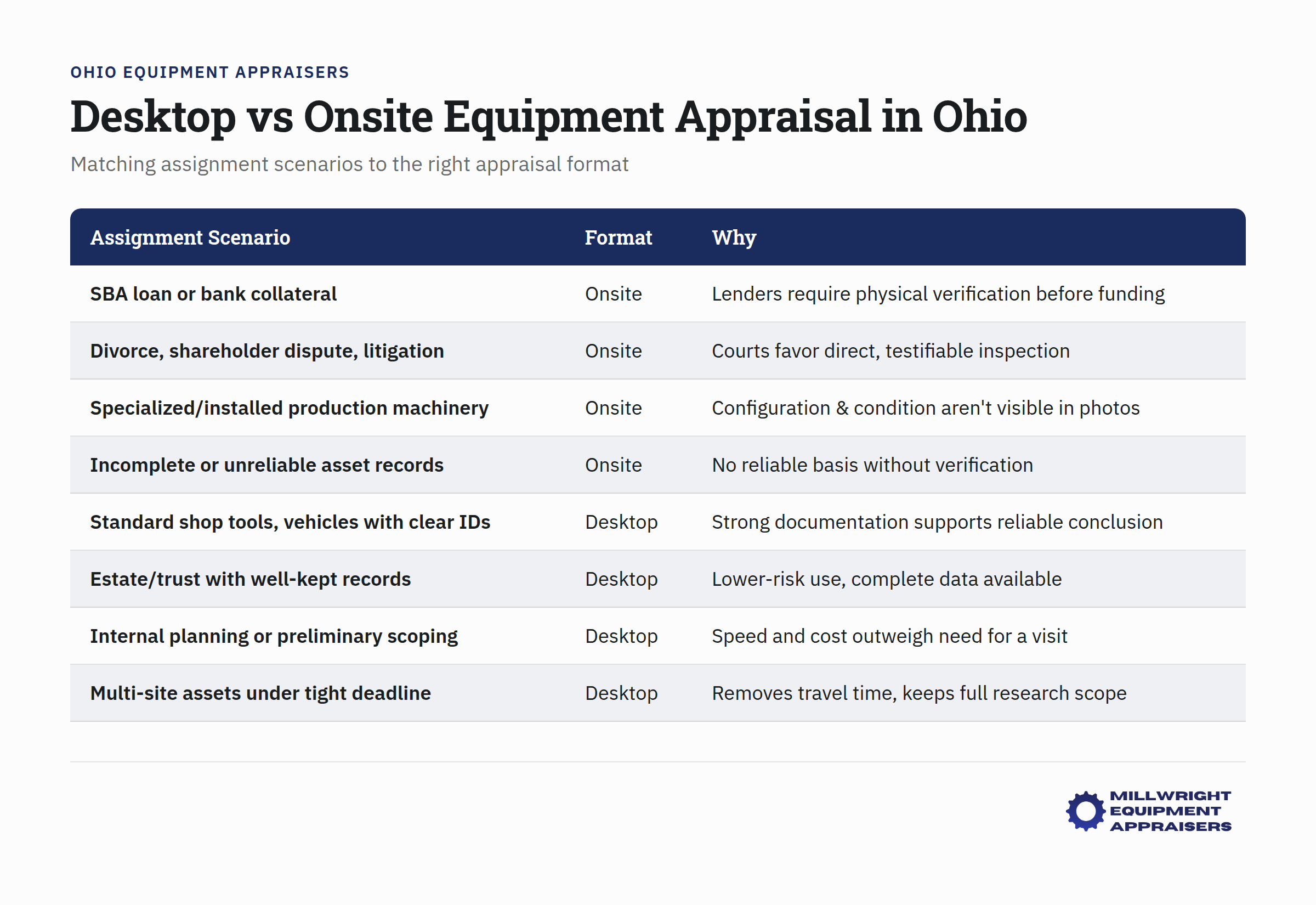
The table below summarizes how the two formats typically apply across common Ohio assignment types.
| Assignment Scenario | Typical Format | Why |
|---|---|---|
| SBA loan or bank collateral | Onsite | Lenders generally require physical verification of collateral before funding |
| Divorce, shareholder dispute, litigation | Onsite | Attorneys and courts favor direct, testifiable inspection |
| Specialized or installed production machinery | Onsite | Configuration and condition materially affect value and aren't visible in photos alone |
| Incomplete or unreliable asset records | Onsite | Nothing to build a credible desktop opinion on without verification |
| Standard shop tools, vehicles with clear IDs | Desktop | Strong documentation supports a reliable conclusion without a visit |
| Estate or trust with well-kept maintenance records | Desktop | Lower-risk intended use, complete data available |
| Internal planning or preliminary scoping | Desktop | Speed and cost outweigh the need for physical verification |
| Multi-site assets under a tight deadline | Desktop | Travel time removed while research and documentation stay full scope |
How Fees Differ Between the Two Formats
Onsite appraisals generally cost more than desktop appraisals for the same equipment, because travel time and on-location data collection add to the scope of work. This is a scope difference, not a value-side one: the equipment's condition or market value doesn't change what we charge, but the amount of appraiser time required to complete the assignment does.
For machinery and equipment appraisals, standard desktop reports start at $295, with IRS-qualified (advanced) reports starting at $395. Most engagements run $695 to $3,000 depending on the number of assets and depth of analysis required, and the most complex industrial projects can run $5,000 to $10,000 or more. Every engagement is quoted as a fixed fee after we understand the scope, never billed hourly, whether the assignment ends up desktop or onsite.
Ohio's Manufacturing Base Makes the Decision More Common, Not More Complicated
Ohio's industrial and agricultural equipment base means these questions come up constantly, from a Cleveland-area manufacturer refinancing a stamping line to a family in Dayton settling an estate that includes farm implements. The presence of that equipment doesn't change the framework. Ohio courts, banks, and the IRS all operate under the same USPAP scope-of-work logic described above; there's no separate Ohio statute dictating desktop versus onsite. What matters is matching the format to the intended use and the quality of the records in front of the appraiser.
Key takeaway: if your assignment involves a lender, a courtroom, or specialized machinery with thin documentation, plan for an onsite inspection. If your equipment is standard, well-documented, and the intended use carries lower risk, a properly scoped desktop appraisal will hold up just as well, at a lower cost and faster turnaround.
If you're not sure which your Ohio assignment needs, we scope it with you before quoting a fee. Request an appraisal and we'll recommend the format that fits your intended use, timeline, and records.
This article is provided for general informational purposes only and does not constitute legal, tax, or financial advice. Readers should consult a qualified attorney or CPA regarding their specific circumstances.